More than one product.
A clearer place to start.
Help shoppers inspect which stores carry their whole list and which items are missing elsewhere.
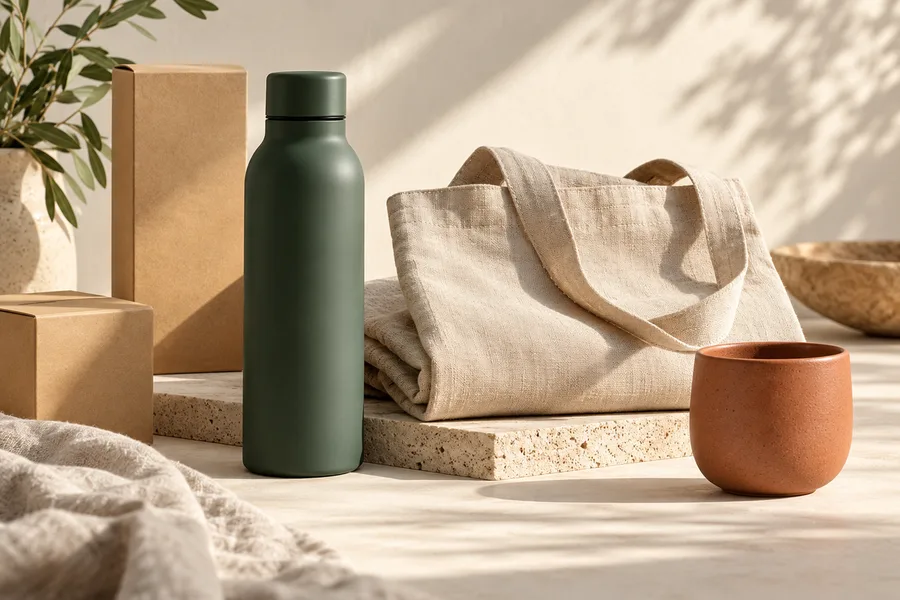
See customer tasks in the product
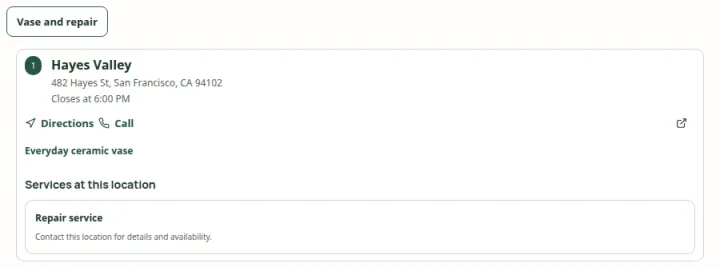 Open capture
Offer a named product or service task, then show the places that match its exact criteria. Actual product · Fictional project data.
What this setup includes
- Exact two-product list examples
- Complete and partial store coverage
- Clear stock uncertainty
Example networks
- Brand stockists
- Specialty retail
- Dealer networks
- Gift and homeware shops
“Which place carries both the vase and the tote?”
The sample list identifies one complete assortment and a partial alternative. Choosing the tote and candle instead leaves only partial matches, so the example never promises a one-store answer that the data cannot support.
Information behind the answer
- List
- Two exact product identities
- Coverage
- Complete and partial store assortments
- Availability
- Stock and reservations remain unknown
Try this question.
A small shopping listCan I find these two products at one place?
Can I find these two products at one place?
Compare complete and partial assortment coverage without assuming shelf stock.
1 sample place carries the complete list. Stock and reservations are unknown.
Willow & Clay
Complete list- Carries: Everyday vase, Canvas tote
- Complete assortment for this sample list.
Sunday Supply
Partial list- Carries: Everyday vase
- Missing: Canvas tote
No sample place carries an item from this list.
Plan your locatorFixed fictional example · 28 October 2026 · Visit times use America/Los_Angeles. No live stock, booking or enquiry is requested.
Who uses this setup.
Assortment teams
Maintain exact products and their store assignments.
Store operators
Keep each collection useful as ranges change.
Shoppers
Find a complete assortment or understand what is missing.
Keep the list exact.
Use the product or variant the shopper selected. A related item cannot silently fill a missing list entry. Maintain the effective collection at each location so complete and partial results explain a useful difference.
- Use stable product identifiers.
- Show the missing item beside a partial match.
- Keep list coverage aligned with published store assignments.
Explain the next decision.
A complete assortment can help someone choose a store to contact or visit. It does not establish current shelf stock, quantity or a reservation. If no store carries the whole list, make that result clear.
- Distinguish assortment from a fresh stock observation.
- Keep public prices and missing prices understandable.
- Treat two-store optimization as a separate requirement.
Your starting plan.
Prepare the range
Review products, variants and store-specific collections.
Try a small list
Check a complete result, a partial result and a list with no complete store.
Review the next step
Inspect the relevant store and its contact or directions destination.
Before you begin.
Does a complete list mean the items are in stock?
No. This example evaluates assortment. Live stock observations, quantities and reservations require their own authoritative source and workflow.
What if no store carries everything?
Partial results identify the carried and missing items. The sample tote-and-candle list deliberately demonstrates this outcome.
Can the list combine different variants?
Exact product and child-SKU identities matter. The selected variant must be assigned to a store; a related variant cannot fill the gap silently.